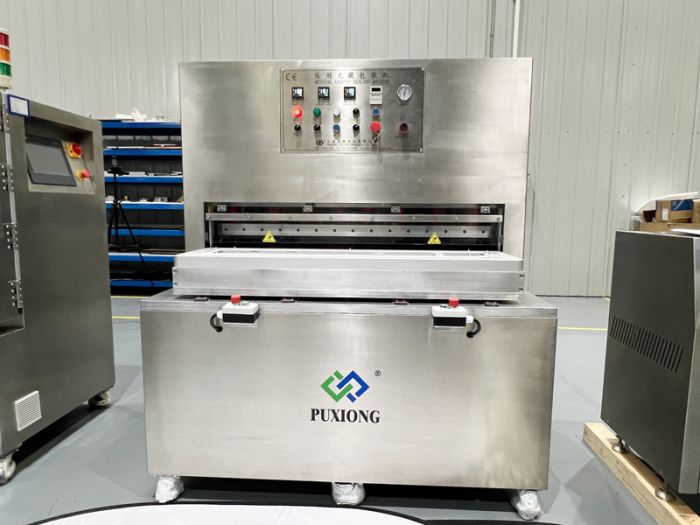
The operation process for batch use of double-chamber vacuum sterilization bag sealing machines
The operation process and precautions for batch use of double-chamber vacuum sterilization bag sealing machines are as follows:
I. Batch Operation Process
Equipment Preheating and Parameter Setting
Connect the power supply and preheat the equipment to the appropriate working temperature.
Set the vacuuming time, sealing temperature and sealing time according to the material (such as paper-plastic bags, aluminum foil bags) and thickness of the sterilization bags. For example:
Thin bags: low-temperature sealing (about 2 seconds), vacuuming time 10-25 seconds.
Thick bags/aluminum foil bags: high-temperature sealing (3-4 seconds), vacuuming time 25-40 seconds.
Batch bagging and placement
Place the items to be sterilized into the sterilization bags, ensuring that the bag opening is flat without wrinkles and the contents are at least 2.5 cm away from the bag opening.
Put the sterilization bags with the items into the left vacuum chamber of the double-chamber vacuum machine, align the bag opening with the sealing strip, and press down the pressure strip to fix it.
Simultaneously place the next batch of sterilization bags to be sealed in the right vacuum chamber to achieve alternating operation of the left and right chambers.
Vacuuming and sealing
Close the left vacuum chamber door and lock it. Start the vacuum pump to extract air. Observe the vacuum gauge until it reaches the set value, and then the sealing process will start automatically.
After the sealing is completed, the vacuum chamber door will pop open automatically. Take out the sterilization bag that has been sealed.
Press the left vacuum chamber pressure bar to the right and repeat the vacuum extraction and sealing process for the right vacuum chamber.
Cycle operation and quality inspection.
Alternate the use of the left and right vacuum chambers to form a continuous production cycle.
After each batch is sealed, check the sealing of the bag opening:
Visual inspection: The seal has no wrinkles or contamination, and the sealing width is 8-10 millimeters.
Fusion test: The inner film is completely fused.
Tensile test: Use a tensile tester to test the strength of the seal.
II. Key Precautions
Parameter matching
Adjust parameters according to the material of the sterilization bags:
Paper-plastic bags: Sealing temperature 125-175℃, vacuum degree ≥ 53.33kPa.
Aluminum foil bags: Require high-temperature sealing (170-175℃) to avoid poor sealing due to low temperature.
Operating procedures
Bag opening treatment: Ensure the bag opening is dry and free of contamination, and the contents are at least 3 centimeters away from the bag opening.
Avoid overlapping: When placing the sterilization bags in the vacuum chamber, make sure they are flat to prevent displacement during sealing.
Alternating efficiency: When operating the left and right chambers alternately, prioritize sealing items with higher priority.
Safety and maintenance
Safety Precautions: Wear protective gloves during operation to avoid contact with high-temperature sealing strips and vacuum pumps.
Equipment Cleaning: Clean the vacuum chamber and sealing strips daily, and replace the filter and sealing strips monthly.
Parameter Calibration: Regularly check the vacuum gauge and temperature controller to ensure accurate parameters.
III. Advantages of Batch Operations
Efficiency Enhancement: The dual-chamber design allows vacuuming and sealing to overlap, increasing production efficiency by more than 50% compared to single-chamber machines.
Stable Quality: Uniform parameter settings reduce human errors, with a sealing qualification rate of over 99%.
Wide Applicability: It can handle sterilization bags of different materials and sizes, meeting the needs of multiple industries such as medical devices and pharmaceuticals.