
Analysis of the Precision Advantages of High-Frequency Heat Sealing Machines in the Welding of Medical Liquid Bags
I. Core Precision Advantages
.jpg)
Positioning Control
* Mold Precision: Utilizing CNC-machined molds with dimensional tolerances ≤ ±0.01mm, ensuring precise matching between the welding area and the infusion bag interface. For example, in balloon catheter welding, the mold must precisely align with the connection point between the catheter and the balloon to prevent welding misalignment and leakage.
* Mechanical Guiding System: Equipped with linear guides and ball screws, the vertical lifting repeatability of the welding joint reaches ±0.02mm. During infusion bag interface welding, the mechanical system ensures the welding joint is accurately pressed into the center of the interface, preventing uneven sealing.
* Response Control
* High-Frequency Electromagnetic Field Start/Stop: Employing an IGBT solid-state high-frequency generator, the high-frequency electromagnetic field can be started and stopped within 1ms, preventing thin-walled infusion bags (thickness 0.1-0.3mm) from burning through or failing to weld properly due to excessive heating time.
* Pressure and Time Closed-Loop Control:
* Pressure Precision: The servo pneumatic system is equipped with a high-precision proportional valve and pressure sensor to monitor the welding pressure in real time (range 0.1-10MPa), dynamically adjusting fluctuations ≤ ±0.05MPa. For example, in artificial blood vessel fusion, constant pressure avoids uneven pressure leading to variations in vessel wall thickness.
Time Accuracy: Fusion time is timed via a microprocessor with an accuracy of ±0.01 seconds, preventing excessively long or short heating times from affecting weld strength. Fusion time for infusion bag interfaces is typically controlled between 0.5 and 2 seconds.
Weld Uniformity Control
Uniform Heating Technology:
Plate Electrode Design: Utilizing large-area plate electrodes (100-300mm in diameter) ensures a uniform high-frequency electromagnetic field covering the fusion area, preventing uneven heating due to electrode shape. For example, in the composite fusion of hospital bed sheets, plate electrodes ensure that every part of the fabric and plastic film reaches a molten state.
Electromagnetic Field Simulation Optimization: Electromagnetic field distribution is simulated using finite element analysis (FEA) to optimize electrode structure (e.g., slotted or raised designs), eliminating "cold zones" (temperatures below the material's melting point) at the fusion edges. In catheter branch fusion, simulation optimization ensures temperature uniformity at branch connections ≥95%.
Multi-stage Pressure and Temperature Control:
* **Segmented Heating Strategy:** The welding process is divided into three stages: preheating, welding, and pressure holding. Temperature and pressure are independently controlled in each stage. For example, in the welding of the airway and fabric in an anti-decubitus mattress, low-power heating softens the material during the preheating stage, high-power rapid fusion occurs during the welding stage, and constant pressure ensures a tight bond between the welded layers during the pressure holding stage.
* **Temperature Gradient Control:** For multi-layer material welding (such as PVC + fabric), precise temperature matching between layers is achieved by adjusting the distance between the electrodes and the material or by adjusting the power distribution. In the composite welding of surgical gowns, the outer PVC layer needs to reach its melting temperature (approximately 160℃), while the inner fabric layer needs to be kept at a low temperature (≤80℃) to avoid scorching.
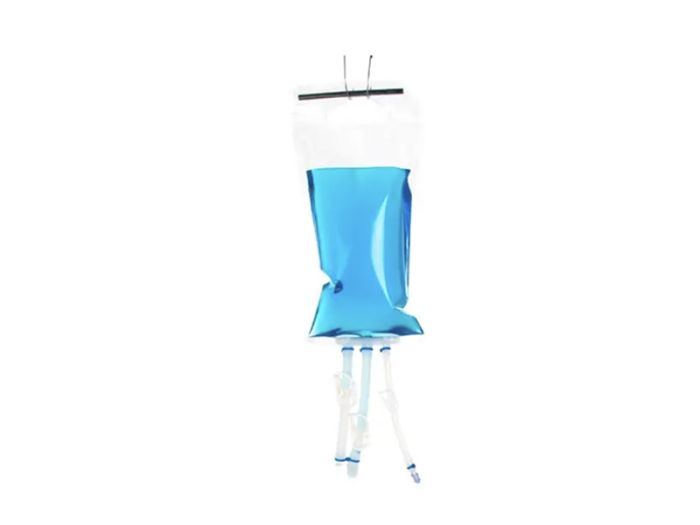
* **Medical Infusion Bag Application Case:** Welding of Infusion Bags and PVC Tubes
* **Accuracy Requirements:** Welding strength ≥25N (industry standard ≥15N), no leakage during negative pressure testing (-80kPa for 1 minute).
* Technical Implementation:
* **Multi-station Turntable Design:** Achieving simultaneous "loading-welding-cooling-inspection-unloading" operations via 180-degree rotation of dual turntables. The 6-station system boasts a daily capacity of 20,000 units, a 6-fold increase in efficiency compared to traditional single-station systems.
* **Pressure Closed-Loop Control System:** Equipped with high-precision pressure sensors and proportional valves, ensuring pressure fluctuations within ±0.02MPa. This guarantees no perforation in thin-walled tubing (0.2mm thickness) and a weld depth ≥1.2mm for thick-walled liquid bags (3mm thickness).
**Results:** Product defect rate reduced from 5% to 0.2%, meeting the safety requirements of the high-end medical market for infusions.
* **Biodegradable Material Welding (PLA/PBS)**
* **Precision Requirements:** Welding strength reaches 22N/15mm, with no delamination in the peel test, meeting USP Class VI biocompatibility standards.
* **Technical Implementation:**
* **Dynamic Frequency Adjustment:** Achieving non-destructive welding through adaptive adjustment from 27.12MHz to 40.68MHz.
Solvent-free welding process: Reduces VOC emissions by 95%, supporting companies in obtaining "Green Medical Supply Chain Certification".
Benefits: Supports the application of PLA/PBS biodegradable materials in the medical field, meeting both environmental protection and biosafety requirements.
.jpg)