Heat sealing technology for disposable 3D liquid storage bags
The heat-sealing technology for disposable 3D liquid storage bags is a critical process ensuring their sealing integrity and sterility. It primarily involves high-frequency welding, constant-temperature welding, and corresponding detection technologies. Below is a summary of key technical points:
.jpg)
1. Comparison of Mainstream Heat-Sealing Technologies
High-Frequency Welding
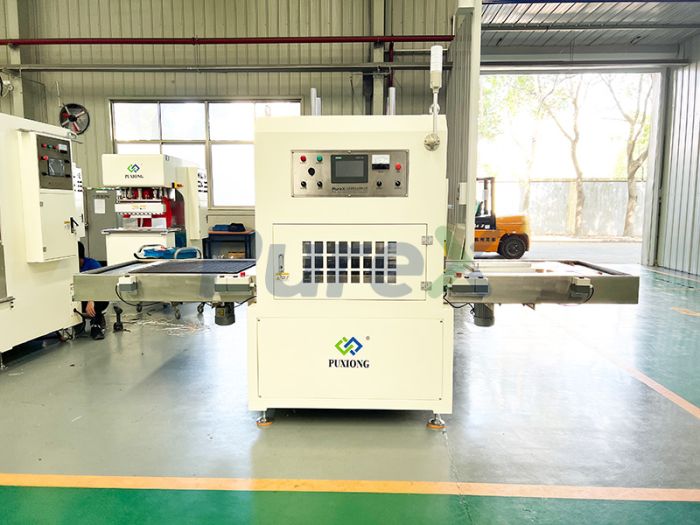
Suitable for polar materials such as PVC and TPU, this method uses a high-frequency electromagnetic field to generate heat through molecular friction, achieving fusion. It delivers high weld strength and stable sealing performance.
PuXiong equipment incorporates intelligent current control technology, enabling precise adjustment of welding temperatures to accommodate the three-dimensional structure of 3D liquid storage bags.
Constant-Temperature Welding
Used for non-polar materials, this technique achieves rapid fusion through localized high temperatures, with a minimal heat-affected zone.
Aseptic docking stations employ constant-temperature technology to ensure sterile connections between tubing and bag assemblies.
2. Key Process Controls
Temperature and Pressure: Parameters must be adjusted based on membrane material characteristics (e.g., ETFE, TPU, PVC) to prevent thermal deformation or sealing failures.
Sealing Integrity Testing: Pressure decay methods (e.g., Leak-SUS testers) are used, with detection accuracy up to 1 Pa, complying with GMP requirements.
3. Industry Application Cases
Biopharmaceuticals: 3D liquid storage bags are used for storing sterile preparations such as vaccines and antibodies, requiring gamma irradiation sterilization (25-40 kGy).
Customized Solutions: Support for capacity customization from 50 mL to 500 L, with integrated functional modules such as sampling and filtration.
4. Technological Trends
Automation Integration: Incorporation of robotic systems for unmanned production, reducing contamination risks.
3D Printing Technology: An emerging process that may drive innovation in bag structure design, though traditional heat-sealing remains dominant currently.