The heat sealing steps of the ear bulb heat sealing machine
Ear Wash Bulb Thermal Fusion Machine
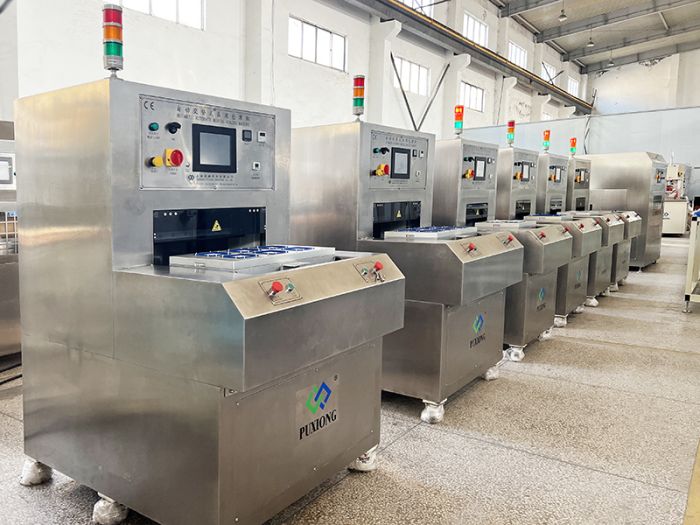
The ear wash bulb thermal fusion machine bonds the components of an ear wash bulb (e.g., bulb body, nozzle, joints) securely using the principles of thermoplastic material heating, melting, and pressure bonding. The specific thermal fusion process involves the following key steps:
.jpg)
1. Material Preparation and Positioning
Material Selection: Ear wash bulbs are typically made of thermoplastic elastomers (e.g., TPE, silicone) or plastics (e.g., PP, PE), which soften upon heating and re-solidify upon cooling.
Component Positioning: Place the components (e.g., bulb body and nozzle) into the machine’s mold, ensuring precise alignment of contact surfaces to prevent air leakage or deformation after fusion.
2. Heating Stage
Heating Methods:
- High-Frequency Heating: Uses a high-frequency electromagnetic field to generate internal molecular vibration and heat. Suitable for high-temperature-resistant materials like silicone, offering uniform heating and fast speed.
- Hot Air Heating: Directs hot air or heated plates onto material surfaces. Ideal for thin-walled components but requires precise temperature control to avoid scorching.
- Ultrasonic Heating: Generates heat via high-frequency vibrational friction. Used for small or precision bonding areas, though costly.
Temperature Control: Set heating temperatures based on material type (e.g., silicone: 180–220°C, TPE: 150–180°C) to ensure softening without decomposition.
3. Pressurization and Fusion
Pressure Application: After heating, the machine’s pneumatic or hydraulic system drives mold closure to apply pressure (typically 0.5–5 MPa) to the softened material.
Fusion Process: Under pressure, molecular interdiffusion occurs at the contact surfaces, forming strong molecular bonds. Pressure must be maintained (e.g., 2–10 seconds) to ensure thorough fusion.
4. Cooling and Solidification
Natural Cooling: After heating stops, the material naturally cools in the mold, allowing molecular re-solidification and bond strength enhancement.
Forced Cooling: Some machines use cooling systems (e.g., air or water cooling) to shorten cycle times and boost productivity.
5. Demolding and Inspection
Demolding: Open the mold and remove the fused ear wash bulb after cooling.
Quality Inspection: Check the fused areas for smoothness, absence of bubbles/cracks, and perform airtightness tests (e.g., inflating the bulb and submerging it in water to check for leaks).
Critical Technical Parameters
- Temperature: Must be precisely controlled to avoid material carbonization (too high) or incomplete fusion (too low).
- Pressure: Adjusted based on material thickness and bonding area to ensure uniform force distribution.
- Time: Heating and pressurization durations must be optimized; excessive time damages materials, while insufficient time weakens bonding.
Applications
Ear wash bulb thermal fusion machines are widely used in medical, laboratory, and industrial fields to produce disposable or reusable bulbs. Some machines support automated production with PLC control systems for precise parameter adjustment, improving efficiency and consistency.